Designing a multilingual customer support model where AI delivers speed, human agents deliver judgement, and both work together as one structured system.
AI Customer Service with Human Support – A Hybrid Multilingual Support Model

AI + Human Customer Support: How We Build a Hybrid Support Model
Businesses don’t really debate whether to use AI powered customer support anymore. That part is settled. Of course you use AI in customer service. It’s faster, cheaper, and doesn’t get tired.
However, most companies make the same mistake. They think of AI in terms of tools. Let’s add an AI chatbot. Let’s improve the model. Let’s train it better. But the issue is rarely the tool itself. It’s the assumption that all customer support interactions can be handled the same way.
They can’t be.
Adding AI on top of an existing support setup doesn’t fix the underlying problem. It often adds another layer of complexity. Even more so, where AI in multilingual customer support is involved. Our AI multilingual customer support services are designed to solve this complexity by combining automation with native-language human expertise rather than relying on AI alone.
Because customer support is not a single system. It’s a combination of conversations, workflows, languages, and decisions that all need to work together.
That’s what we design.
Step 1: Building an AI-Powered Customer Service Strategy Around Real Conversations, Not Technology
One of the biggest mistakes businesses make in multilingual customer support automation is that they treat all queries equally.
They’re not.
Some interactions need speed. Some need judgment. Some need both.
And when all of them are pushed through the same system, inefficiencies and friction begin to build.
We approach it differently. Our multilingual AI customer support solutions strategy revolves around conversation behavior.
Before we design anything, our focus is to understand how your support currently works and where it is breaking.
This is not a high-level discussion. We go into actual support interactions and analyze:
- The types of queries you receive
- Where response times slow down
- Where customers follow up multiple times
- How conversations differ across languages
- Where your team spends the most time
This gives us a clear view of what needs to be automated, what needs human handling, and what needs a combination of both — AI + human customer support, creating a true hybrid AI multilingual customer support framework for businesses serving customers across multiple languages.
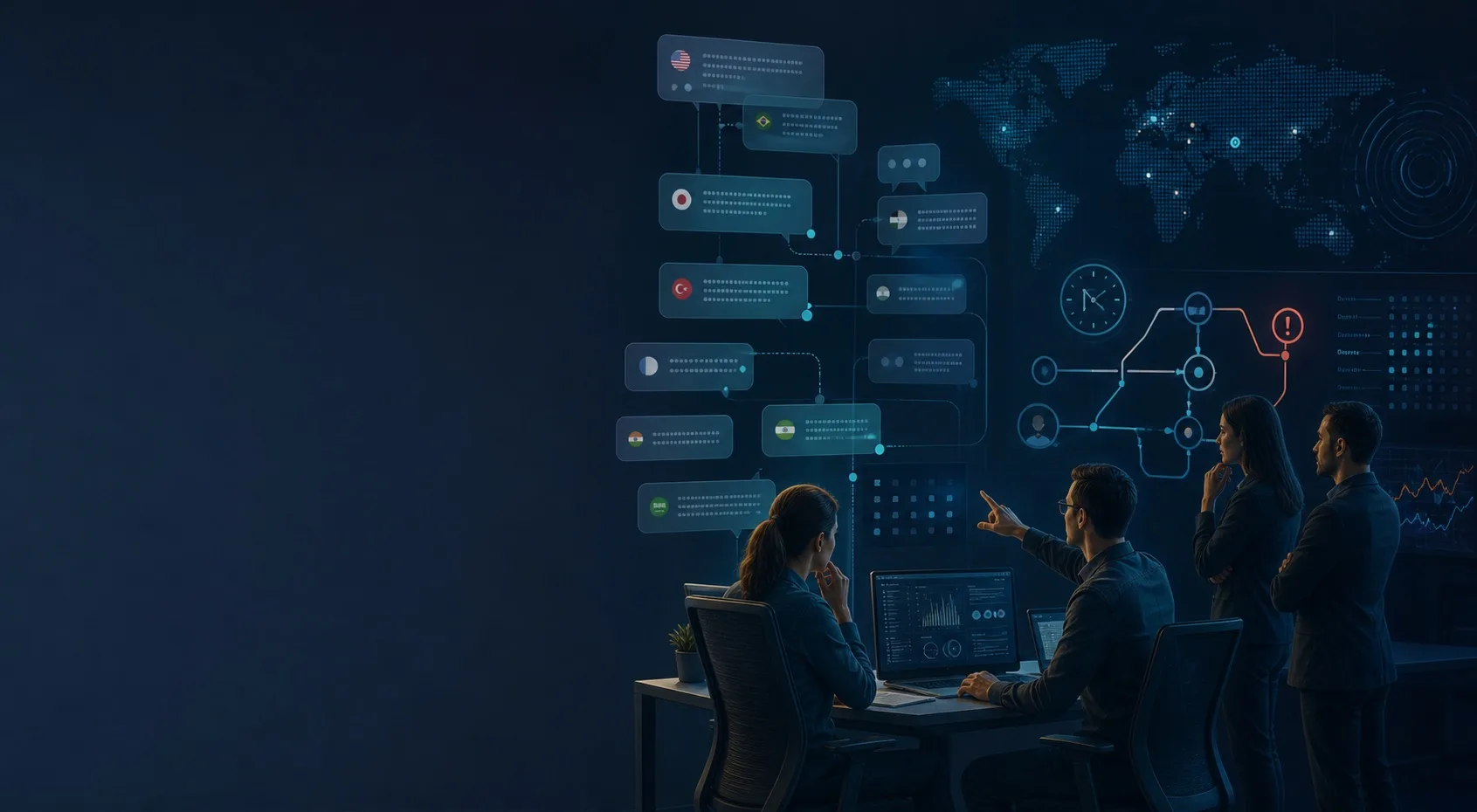
Step 2: Customer Service Automation – Start with Conversation Mapping
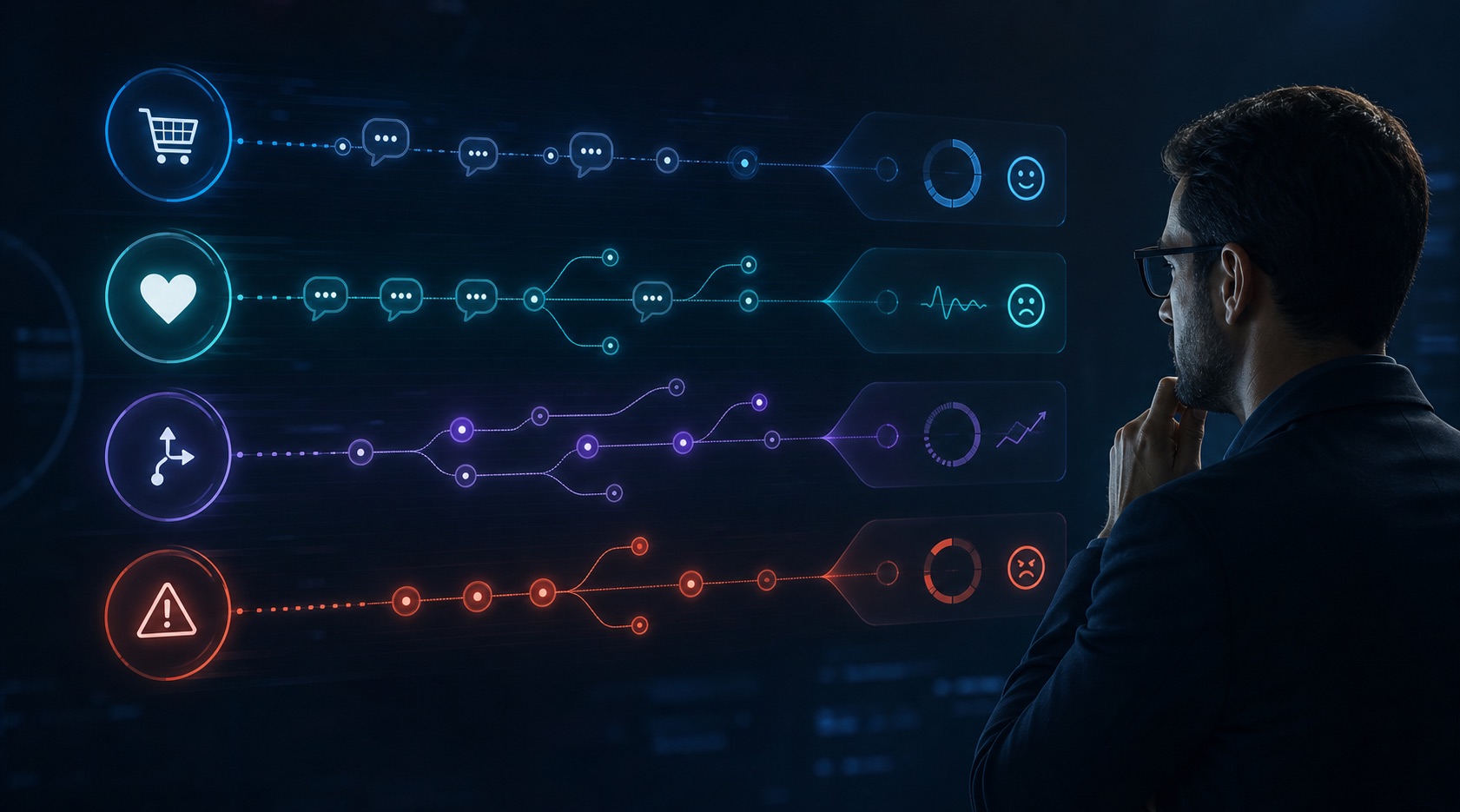
Once we understand the patterns, we group interactions into distinct categories based on how they behave.
Typically, this includes:
Transactional Customer Support Interactions
Straightforward and repeatable. There are some conversations where the customers just want quick answers, not engagement. “Where is my order?” is the simplest example, but there are dozens like it. Resetting a password, checking availability, confirming a booking — these are all situations where speed matters more than conversation.
Emotionally Sensitive Customer Support Interactions
Some interactions carry frustration or urgency. These look simple at first glance but behave very differently once you’re inside it. Refund requests are a good example. There’s a process, a defined outcome, and a standard response. It feels like the perfect candidate for automation. Until you actually read what customers are saying.
They’re rarely just asking for a refund. They’re already annoyed by the time they reach out because something has already gone wrong. The product didn’t arrive, didn’t work, or took too long. The request carries emotional context — even if the words don’t explicitly show it.
AI chatbots tend to respond to the request, not the situation. So it says the right thing, but not necessarily in the way the customer expects it. And that’s enough to push the conversation into a loop. The customer repeats themselves, the AI chatbot repeats itself, and eventually a human customer support agent steps in — but now they’re dealing with a more frustrated customer than they would have at the start.
Evolving & Complex Customer Support Interactions
Where the problem is not fully defined at the start. This category doesn’t show up as frequently but takes up a disproportionate amount of time. Technical issues, configuration problems, anything that requires a bit of back-and-forth to even understand what’s going on.
AI chatbots don’t collapse in these situations — they actually sound quite confident. That’s part of the problem. They give answers that seem correct, the customer tries them, they don’t work, and the conversation continues in circles. By the time a human takes over, time has already been lost.
High-Risk Customer Support Interactions
Where accuracy and trust are critical. These are conversations where you simply can’t afford to get things wrong. Financial disputes, sensitive complaints, anything involving risk or high-value customers.
You don’t need many of these to cause damage. Even one mishandled interaction can undo a lot of trust.
AI chatbots, in their current form, are not built for this layer. Not because they always fail, but because when they do, they fail without awareness. They answer with the same confidence regardless of certainty. That’s not something you want in situations where accountability matters.
This classification becomes the foundation for everything that follows. The goal of our AI-powered multilingual customer service solutions is not to blindly optimize support as a whole. It’s to handle each type of interaction in the most appropriate way.
Step 3: Building the Right Multilingual Customer Service Automation Model
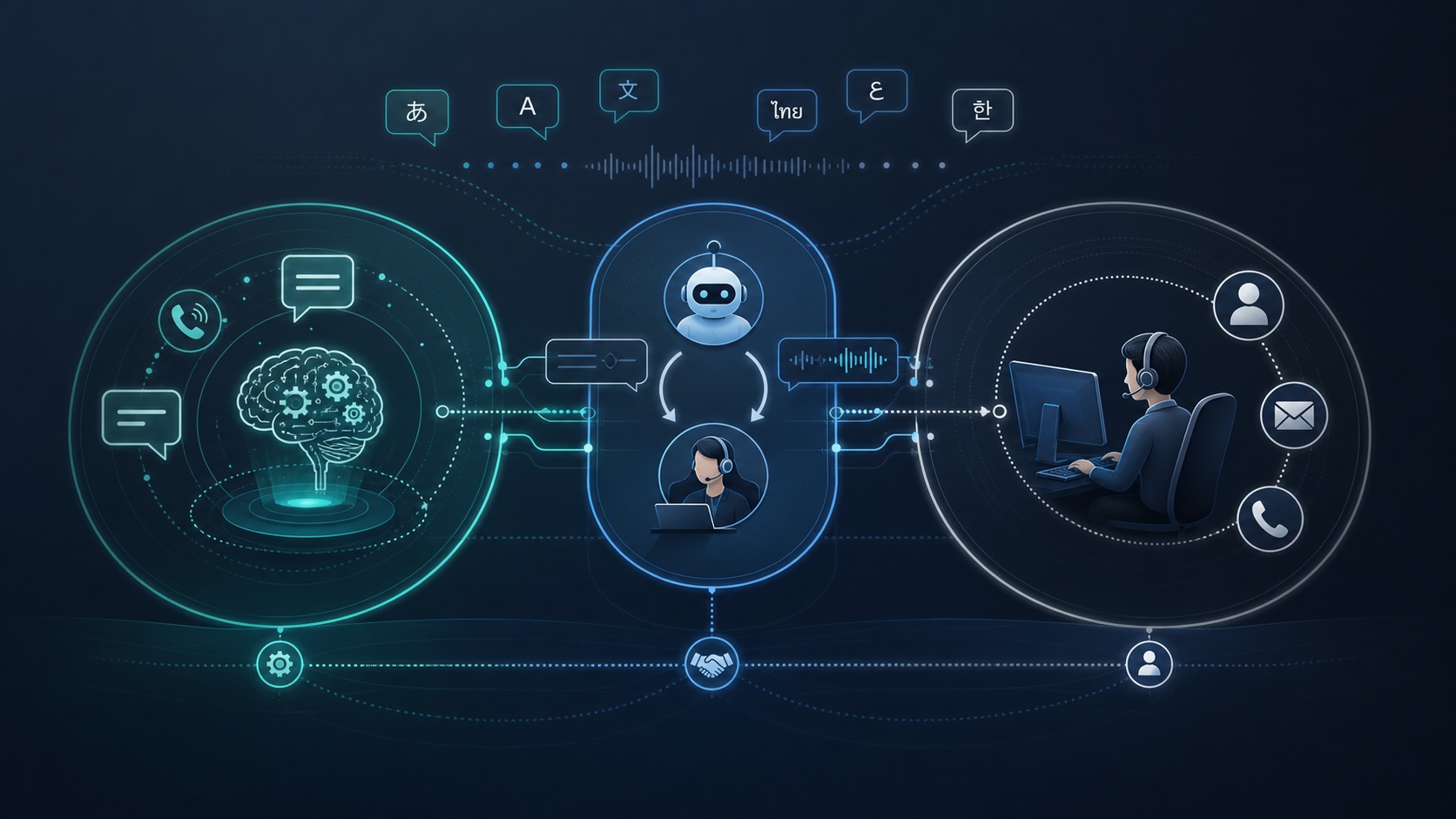
Once interactions are mapped, we build multilingual customer support automation solutions around them — designing how each category should be handled, defining clear handling logic for each, and structuring the system accordingly.
This is where multilingual AI chatbots, native language human support, and hybrid multilingual customer support models are applied — but with clear boundaries.
AI-Led Multilingual Customer Service Automation
Multilingual AI Chatbots are designed to handle high-volume, repeatable queries where speed and consistency matter most, such as transactional ones. In these cases, multilingual AI customer service chatbots work better than humans. Not slightly better — significantly better. Faster, more consistent, and without unnecessary back-and-forth. Even a polite human response introduces delay where none is needed. This is where our multilingual customer support automation services take over completely, supporting customers across different languages.
Hybrid AI + Human Customer Support Model
We design hybrid AI multilingual customer support flows for situations where conversational AI chatbots can assist, but interaction requires human judgment. What works better here isn’t removing automation entirely. It’s changing when it steps back.
The multilingual AI chatbot handles the initial interaction — understanding the query, collecting relevant details, and preparing context, but human agents step in earlier with full visibility, before the tone goes off track. This hybrid AI multilingual customer support approach ensures conversations remain efficient without sacrificing empathy, context, or cultural understanding when multilingual interactions become more complex.
Human-Led Multilingual Customer Support
Human-led flows are reserved for complex or high-risk conversations. In these cases, the most effective approach is to keep AI out of the customer-facing interaction entirely. In the background, it can summarise context, surface relevant knowledge base content or suggest answers, but human support needs to lead the interaction. Customers need to feel like they’re talking to someone who understands the problem, without even noticing that AI is involved.
Step 4: AI-to-Human Handoff – Build Escalation Logic into the Design
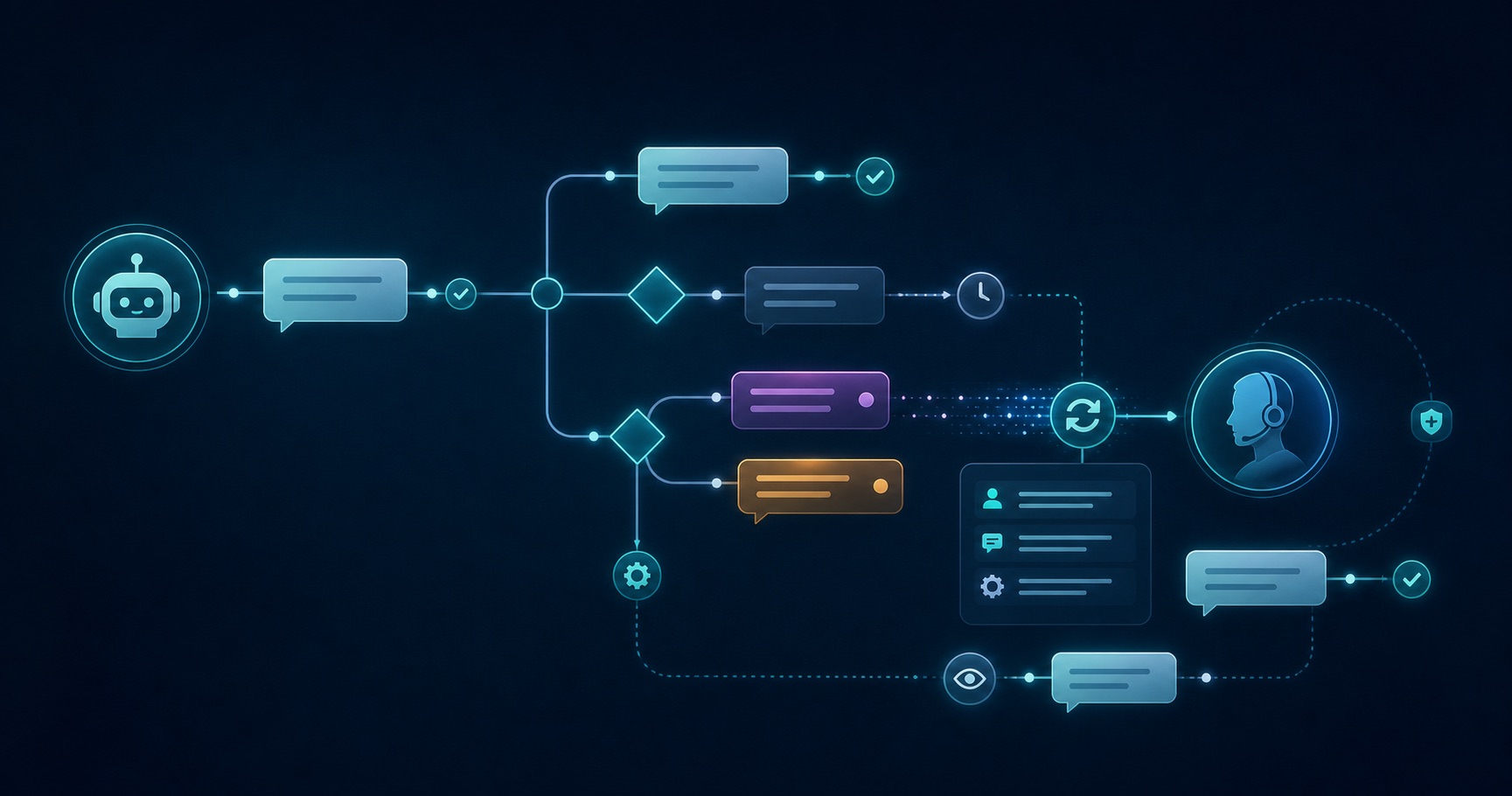
After defining the handling model, we restructure how conversations move through the system.
This includes:
- When an AI chatbot responds directly vs when it routes
- At what point a conversation is escalated
- How context is passed between AI and human agents
- How tone is adjusted before a response is sent
The key difference we make is not the use of these multilingual customer service automation services, it’s the precision in how and where they are applied. Most systems fail because AI is allowed to handle conversations longer than it should. We correct that by defining clear transition points between AI and human involvement.
Challenges in Multilingual AI Customer Support
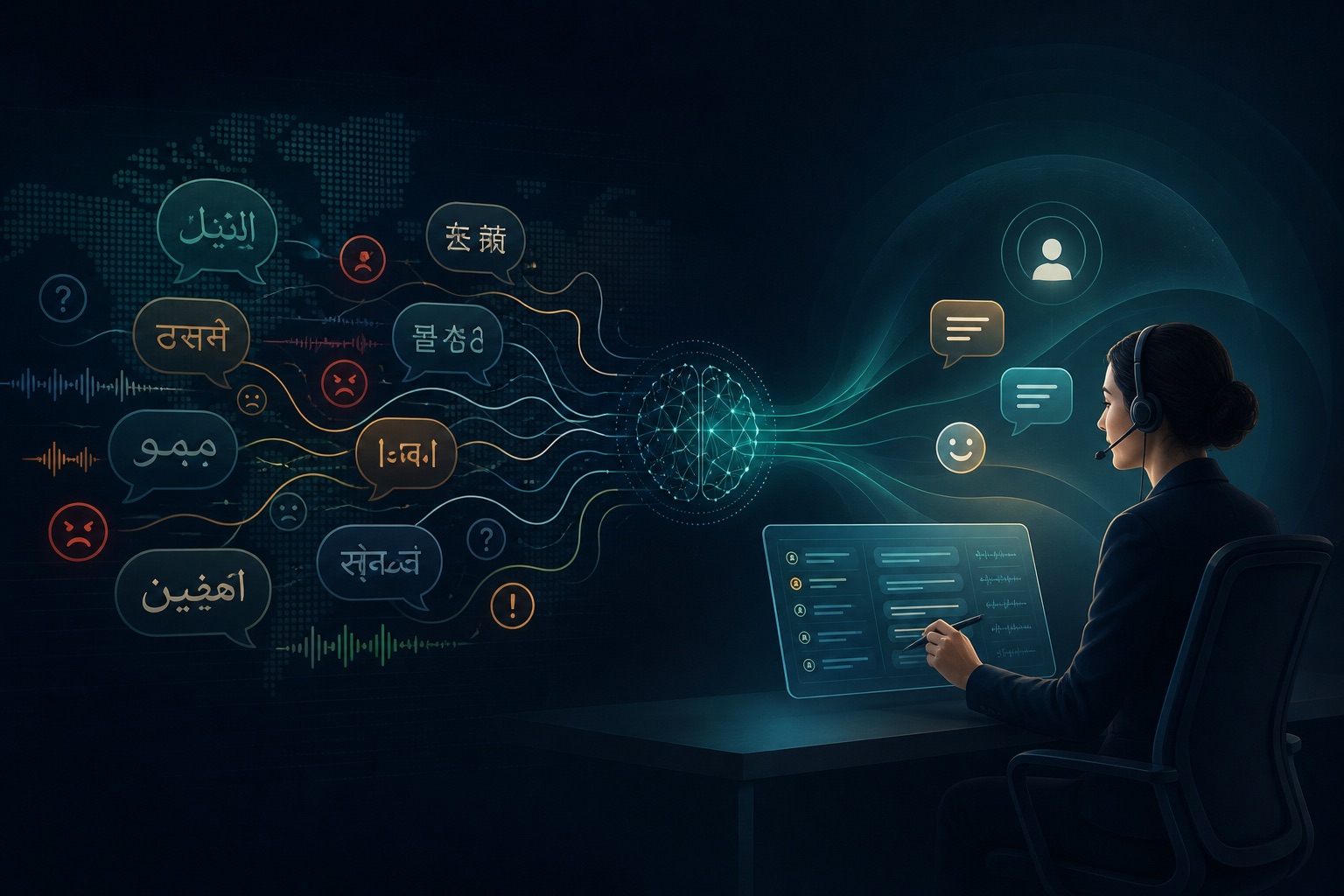
In AI multilingual customer support services, the gap between AI and human agents becomes much more visible. A multilingual AI bot can process multiple languages instantly, but we have seen that it often struggles when conversations move beyond clean translations.
Some scenarios include:
- Detecting intent in mixed-language inputs
- Handling dialects and regional variations
- Translating emotional tone correctly
- Maintaining brand voice across languages
Human agents, on the other hand, may not scale across languages easily, but they understand tone, cultural context, and intent far better. Our AI powered multilingual customer support services are structured to ensure that AI provides speed, while human support provides accuracy, delivering multilingual customer service automation services that feels natural rather than machine translated.
AI-Powered Customer Support Solutions Built Around Your Business
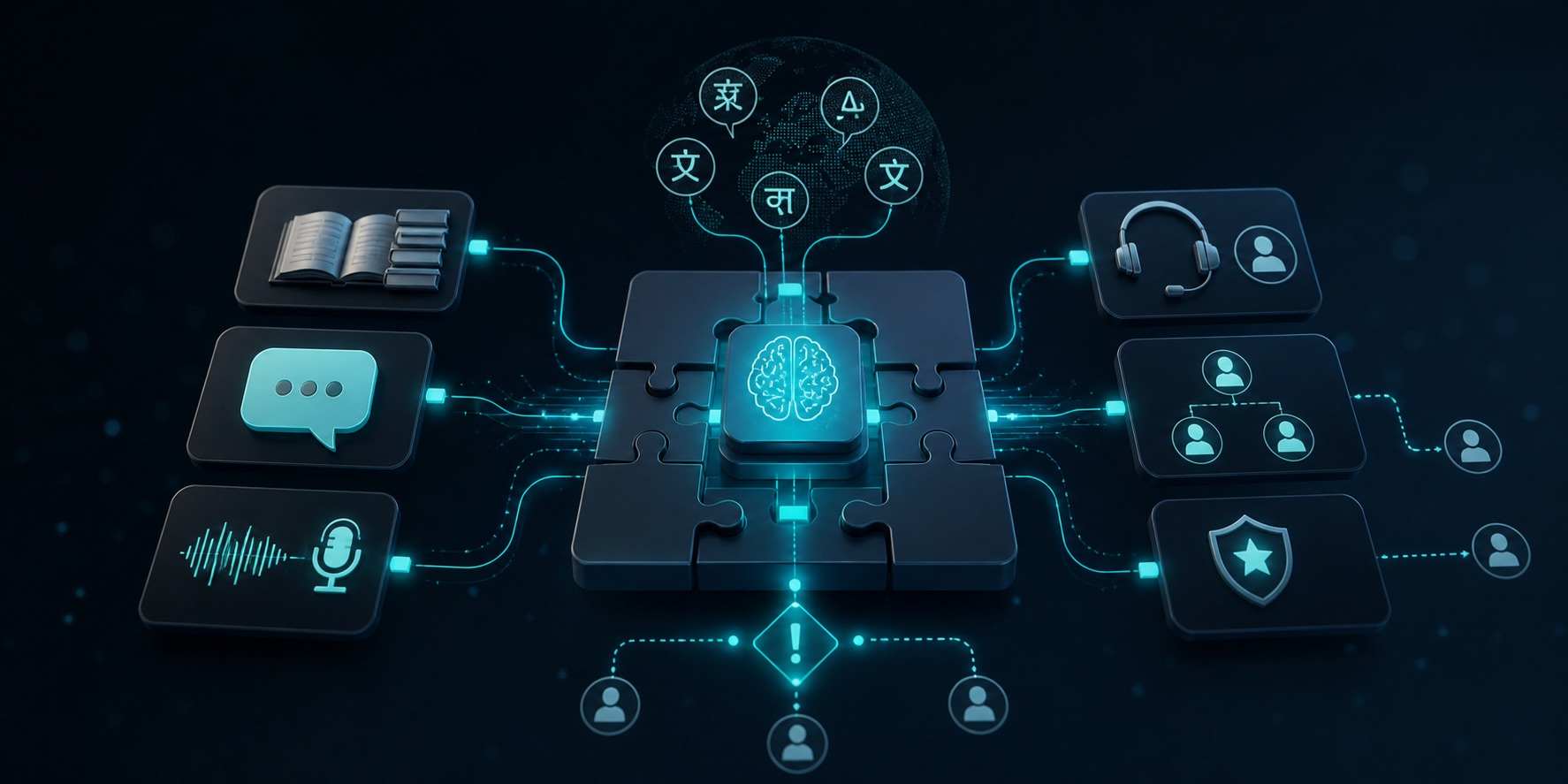
We build a complete AI powered multilingual customer support system for you in a way that fits how your business actually operates.
We don’t give you an off-the-shelf chatbot and ask you to adapt your processes to that platform. Unlike generic AI bots, we implement customized AI bots for you that are trained on a structured knowledge base built specifically for your business. This includes your products, processes, policies, and real customer scenarios.
Our AI powered customer support services include:
- AI Chatbots and AI Voicebots designed specifically around your workflows
- A structured knowledge base that powers those bots
- Human support layers for conversations where judgment is required
- Multilingual handling across channels
- Clear routing, escalation, and response logic
We design everything together instead of adding it piecemeal, ensuring it works as a cohesive system.
Continuous Optimisation of AI-Powered Customer Support Based on Real Conversations
AI powered customer support systems are not static.
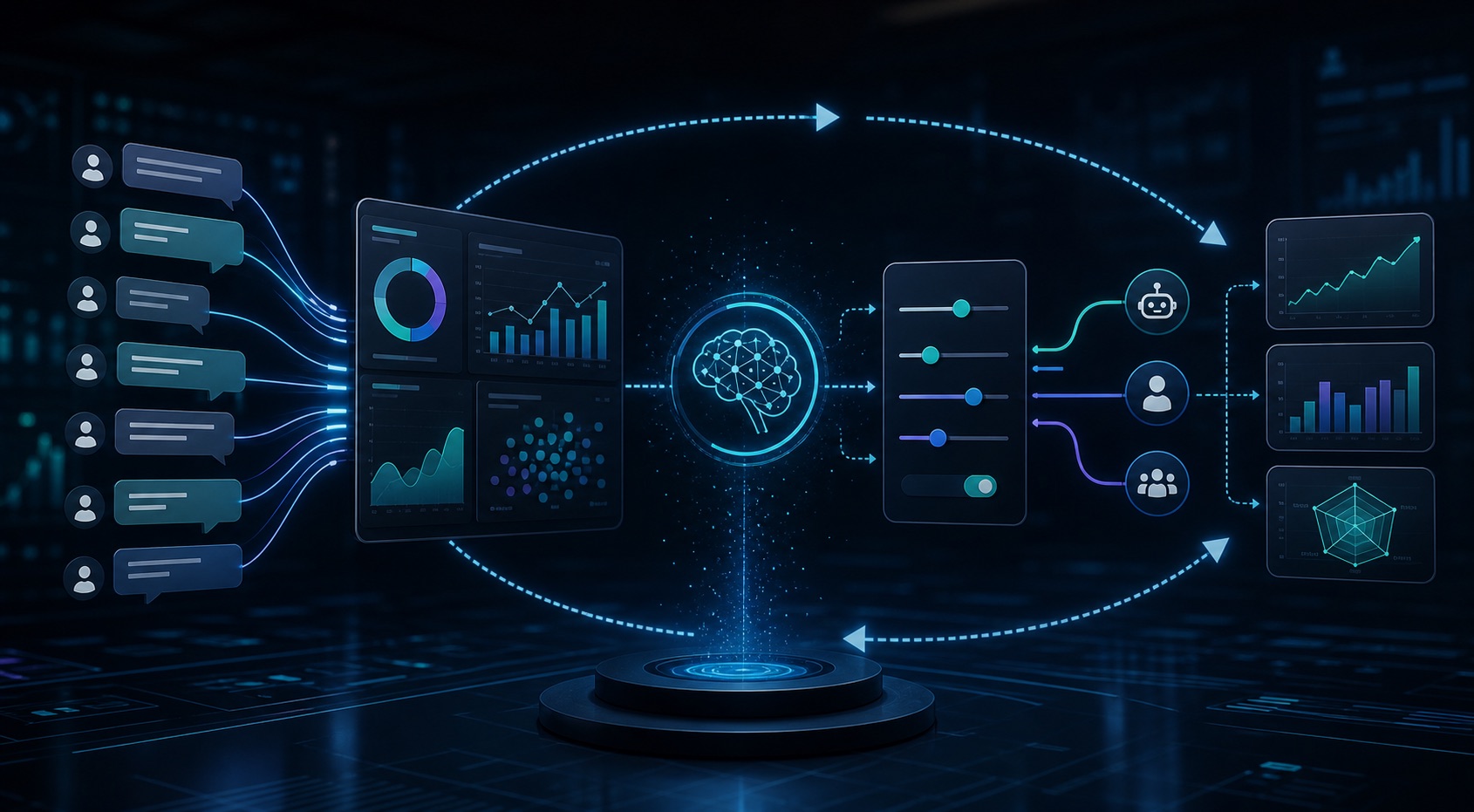
Once implemented, we continue to monitor:
- Where conversations are still looping
- Where customers drop off or repeat queries
- Where escalation patterns change
- How AI performance varies across interaction types
Based on this, we refine:
- AI boundaries
- Escalation timing
- Response strategies
- Interaction routing
The goal is not to maximise customer support automation. It’s to continuously improve how the system handles real-world complexity.
Business Benefits of AI + Human Customer Service for Our Clients
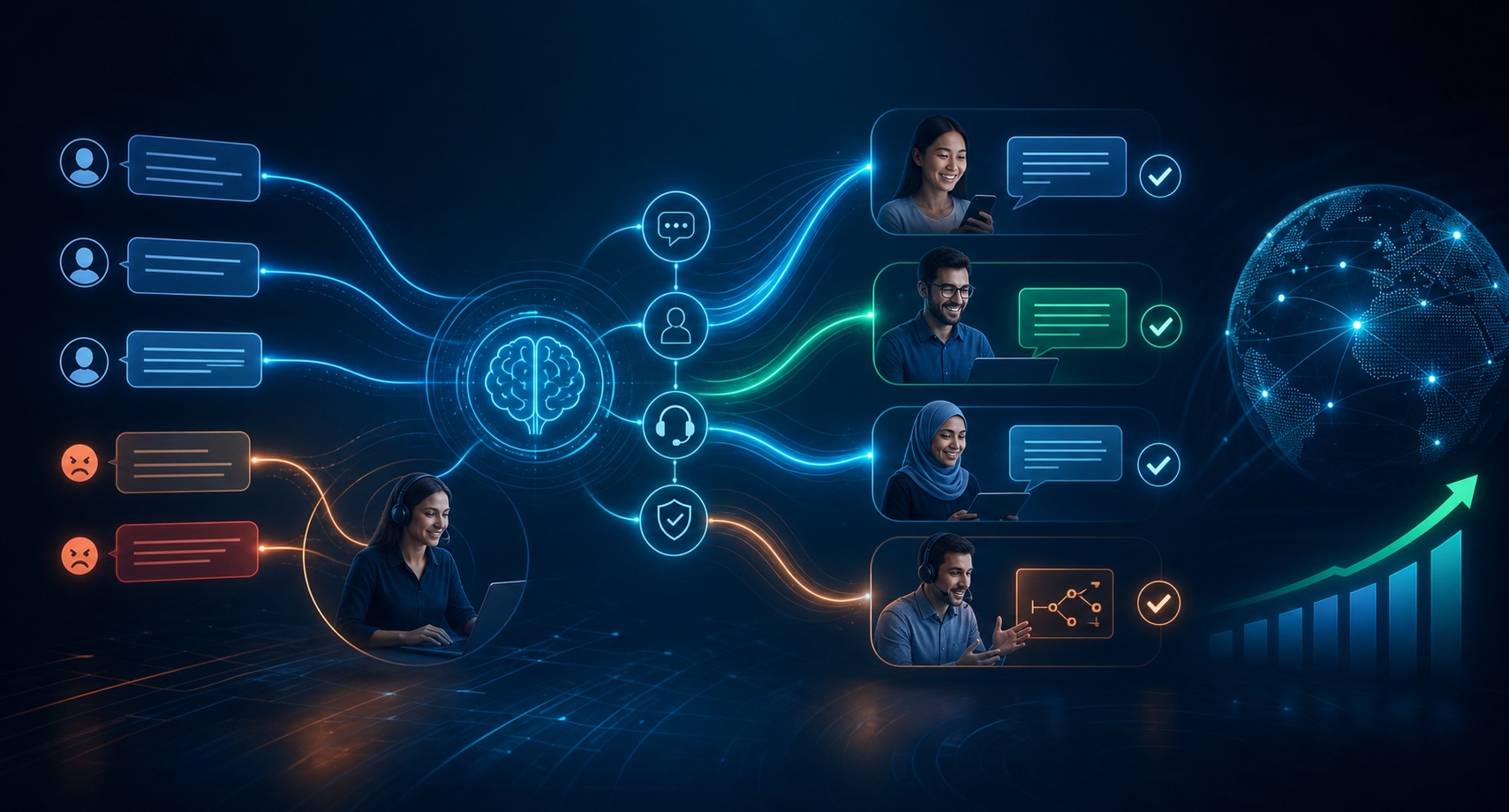
Having implemented customer support automation for a range of clients across different industries, we have seen substantial differences — not just in metrics, but in how support feels.
- Simple queries are resolved instantly, without friction.
- Frustrated customers are handled earlier, before escalation.
- Complex issues are resolved with fewer back-and-forth exchanges.
- Multilingual interactions feel natural, not mechanical.
If you’re trying to move from patchwork AI solutions to a system that actually works in real conversations, we can help you design it end to end.
Frequently Asked Questions About AI + Human Customer Support
How do you decide which customer conversations should be automated and which require human support?
We analyse real customer interactions and classify them according to complexity, emotional sensitivity, risk, repetition, and the level of judgment required. Routine transactional queries may be automated, while complex, sensitive, high-value, or high-risk interactions are routed to human agents.
What happens when an AI chatbot hands a conversation to a human agent?
The handoff should include the conversation history, customer details, intent, actions already taken, and the reason for escalation. This allows the human agent to continue the interaction without asking the customer to repeat information.
How do hybrid AI and human support models reduce the risk of incorrect AI responses?
The model defines clear boundaries for what AI can handle independently. When a conversation is ambiguous, sensitive, high-risk, or outside the approved knowledge base, it is escalated to a human agent rather than allowing automation to continue indefinitely.
Can hybrid AI customer support work with our existing CRM, helpdesk, and internal workflows?
Yes. The model is designed around the company’s existing support workflows, systems, escalation rules, knowledge resources, and customer-service processes. The objective is to make automation work as part of the existing operation rather than operate as a disconnected chatbot.
How does hybrid support handle multilingual conversations and cultural differences?
AI can provide speed across multiple languages, while native-language human agents handle conversations involving tone, cultural context, dialects, emotional nuance, and complex customer intent.
How do you measure whether AI and human support are improving customer service?
A suitable measurement framework can track response time, resolution rate, repeat contacts, escalation quality, customer satisfaction, agent workload, cost per resolution, and the number of conversations requiring human intervention.
How do you prevent customers from being trapped in repetitive chatbot loops?
The support model uses defined escalation triggers and transition points. If the customer repeats the question, shows frustration, provides unclear information, or remains unresolved after a defined number of interactions, the conversation should move to a human agent.
Can AI support be used for high-value, sensitive, or regulated customer conversations?
AI can assist in the background by summarising context, locating relevant information, or suggesting responses. However, customer-facing conversations involving high risk, sensitive complaints, financial issues, or significant consequences should remain human-led.
How is a hybrid AI customer-support system improved after launch?
Real conversations are reviewed to identify incorrect intent detection, unnecessary escalations, repeated questions, weak responses, language issues, and situations where human involvement should begin earlier. The model is then refined based on those findings.
What information is needed to design a hybrid AI customer-support model?
The initial design typically requires customer conversations, common enquiry types, support workflows, escalation rules, service policies, supported languages, knowledge resources, existing systems, and examples of interactions that currently require human judgment.